The article analyzes how Robotic Process Automation (RPA), integrated with Artificial Intelligence, is becoming a strategic lever for the Operations of Italian manufacturing companies, still lagging behind in the field of digitalization. RPA allows automating repetitive processes with high volume — from order management to reporting — by connecting fragmented systems and freeing people for more valuable tasks. The benefits are quick and measurable, but implementation requires a preliminary Lean mapping, solid governance, and an adequate Change Management program to avoid the main risks: cultural resistance, process fragility, and compliance vulnerabilities. The challenge for Made in Italy is not simply adopting AI, but knowing how to put it to work in a scalable and secure way.
Artificial Intelligence and Generative AI are redefining Robotic Process Automation, allowing companies to automate repetitive tasks and optimize operations thanks to adaptive intelligence. RPA tools have been on the market for years, but with the consolidation of AI technologies they are truly entering companies, even within the manufacturing sector.
Italian manufacturing companies boast solid operational maturity in Operations and a well-structured Supply Chain, but they are experiencing delays in overall digitalization. According to our Edizione 2025 | What’s next in Operations? benchmarking study, conducted on a large sample of companies from different sectors, many companies are still operating with manual processes and reactive processes, rather than proactive ones.
Only a minority has reached the status of a Smart Factory, while the majority is defining a roadmap for digital transformation. AI and GenAI are recognized as priorities, with projects initiated primarily for strategic analysis, increased productivity, and the automation of processes. This landscape highlights the opportunity for Made in Italy to accelerate adoption to compete in terms of innovation and value.
Process automation with AI goes beyond traditional automation: it leverages intelligent algorithms to manage routine tasks, predict anomalies, and optimize flows in real time. Generative AI adds an advanced layer capable of generating complex content, codes, or predictions from structured and unstructured data, drastically reducing human intervention.
This approach frees up resources for high-value tasks, such as innovation and strategic problem-solving. In the industrial context, it transforms episodic operations into predictive ecosystems, integrating data from across the value chain to support data-driven decisions.
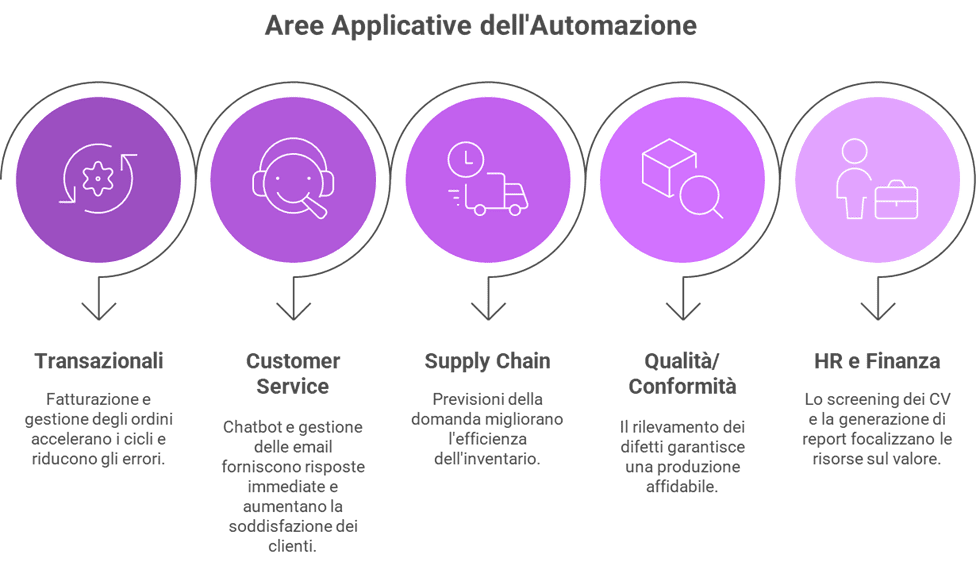
The applications of Process Automation with AI range from transactional processes to production, offering scalable solutions for the Italian manufacturing industry.
Transactional automations manage billing, order processing, and data entry, eliminating manual errors and accelerating cycles. In customer service, AI-powered chatbots and intelligent routing systems filter emails, categorize tickets, and suggest personalized responses, improving the customer experience.
In the Supply Chain, dynamic inventory optimization and demand forecasting reduce stockouts and overstocks. Quality control detects defects in production with high precision, while automated compliance controls verify compliance with regulations at all stages. In IT systems, network monitoring identifies and resolves problems autonomously.
These examples illustrate how AI adapts to the dominant B2B contexts in the Italian sample, enhancing critical areas such as quality and logistics.
The adoption of RPA (Robotic Process Automation), especially when combined with AI, allows for an immediate reduction in the time required for repetitive and high-volume tasks (data collection, updates across multiple systems, controls, reporting, ticket management, and records management), with a direct impact on operational costs, quality, and service levels.
In Operations, RPA becomes the "executive engine" that connects often fragmented tools (ERP, MES, CRM, portals, email, Excel), automating end-to-end flows such as the opening and updating of work orders, the summary and administrative closing, the collection and consolidation of production data, document control, internal request management, the update of master data, the extraction and distribution of KPIs. The result is a more scalable and robust operating model: it increases the share of touchless processes, reduces bottlenecks and "follow-up" activities, and improves the timeliness of information flows.
Integration with Lean paradigms amplifies the benefits: RPA eliminates waste related to unnecessary informational movements, waiting times, rework, and redundant controls, making processes more stable and "to standard work". When paired with AI, the organization moves from reactive management to proactive management: AI detects anomalies and weak signals (performance deviations, downtime risks, quality deviations), while RPA automatically activates standard corrective actions (escalation, task creation, system updates, targeted communications), reducing response times and waste.
ROI tends to emerge quickly in contexts with high repeatability and critical mass (industrial operations, service operations, competence centers, shared services), thanks to modular approaches: starting with "quick win" processes with high volume and low complexity, and scaling up to end-to-end streams. In addition to efficiency, automation also contributes to operational sustainability: fewer rework and informational waste, fewer emergencies generated by misalignment, greater process stability, and higher quality data to measure and govern environmental KPIs (energy, waste, rework).
Measuring the impact of RPA is not just an academic exercise: it is the prerequisite for scaling with awareness. In highly repetitive industrial contexts, improvements manifest themselves across multiple dimensions simultaneously — speed, quality, reliability — and become visible as early as the first weeks of operation. The main indicators to monitor before and after implementation include:
Despite the advantages, the introduction of RPA (and even more so when enabled by AI) brings organizational and technical risks that must be managed with a structured approach. The first is the human and cultural risk: the perception of "substitution" can generate resistance, a decrease in engagement, and defensive behaviors (shadow processes, bypassing rules). To avoid this, transparent communication is essential, as well as involving people in use cases and reskilling/upskilling programs towards "enhanced" roles (managing exceptions, controlling data quality, process ownership, supervising bots and models).
On the operational level, RPA can introduce a risk of process fragility if it automates non-standardized or "exception-filled" activities: a bot replicates what exists; however, if the process is unstable, there is a risk of automating waste instead of eliminating it. This is a typical risk when starting without an end-to-end mapping (Lean/process mining) and without clear rules for managing exceptions and responsibilities (who does what when the bot fails).
In the industrial and regulatory context, alignment with compliance, security, and auditability is crucial. Bots access systems and data: if identity management, segregation of roles (SoD), action traceability, and access control are not properly defined, legal and operational risks (errors in sensitive data, procedural violations, audit difficulties) arise. Cybersecurity is also a concern: hardcoded credentials, shared accounts, or uncontrolled logs can become vectors of risk.
From the IT side, integration with legacy systems or unstable interfaces can lead to technical debt: many "UI-based" automations are sensitive to changes in screens, fields, or permissions, with an increase in bot maintenance and downtime. Without governance, a “jungle of scripts” can be created that is difficult to maintain, with impacts on operational continuity and unexpected costs.
When AI is added (e.g., document classification, data extraction, intelligent routing), additional risks emerge: data quality, model drift, degradation of performance over time, and the need for continuous monitoring. In these cases, defining confidence thresholds, sample controls, and "human-in-the-loop" for ambiguous cases becomes essential to avoid systematic errors that propagate rapidly.
Finally, there are economic and delivery risks: initial costs (licenses, setup, change management), excessive expectations ("RPA solves everything"), the wrong prioritization, and time-to-value that lengthens if you start with overly complex processes. The most common barriers remain: poor data quality, complexity of integration, lack of standardization, absence of ownership and governance.
AI-based process automation implementation strategies are based on structured and gradual approaches. Mapping high-volume and low-value-added processes – the so-called "low-hanging fruits" such as reporting or billing management – forms the starting point. A rigorous evaluation of data quality and the selection of reliable vendors precede the launch of pilot projects on one or two specific use cases.
The scaling phase takes place through integration with ERP and MES systems, with constant monitoring of KPIs such as cycle times, error rates, and overall ROI. Change Management plays a central role: continuous training programs on the potential and limitations of AI contribute to reducing internal resistance, while the involvement of corporate leadership fosters the development of a data-driven culture.
Vendor management is based on clear Service Level Agreements (SLAs), strategies to avoid lock-in, and customized solutions. Ethics and governance – through AI committees, periodic audits for biases, and transparency protocols – ensure responsible use, particularly crucial for black-box generative models.
From the results of the 2025 edition of the Benchmarking Study | What’s next in Operations?, it emerges that the potential is still unexplored, with an implementation level around 10% among the sample of over 100 cross-industry companies. The most involved areas are manufacturing, quality, and customer experience. Based on our experience, cybersecurity, which is often reactive, must be integrated by design into IoT and AI to protect connected operations.
Generative AI is moving from being a "support tool" to an active component of processes: it not only produces content, but also enables agents capable of orchestrating tasks across multiple systems, handling exceptions, learning from feedback, and resuming flows when they are interrupted (self-healing). For Made in Italy this means a paradigm shift: less time spent chasing information, aligning data, and coordinating micro-activities; more time dedicated to decision-making, quality, service, and innovation. Value does not come from “AI” per se, but from its integration into an operational architecture composed of standard processes, reliable data, clear rules, and defined responsibilities.
This transition is not automatic: it requires targeted investment in training, Knowledge Management and new roles (Process Owner, Automation Lead, Bot/Agent Supervisor) to avoid the "eternal pilot" effect and transform technology into industrial capabilities. In practice, what is needed are: a Lean base to reduce variability and waste before automating; governance that guarantees quality, safety and audibility; and a corporate knowledge asset (standards, procedures, lessons learned) "readable" even by machines, so that agents operate consistently and continuously.
Bonfiglioli Consulting, thanks to the Knowledge Office and the Lean Factory School®, accompanies companies in combining Operations Excellence and AI: from the design of processes and the operating model, to the selection of high-impact use cases, up to the construction of internal skills and mechanisms for continuous improvement.
Process automation is no longer just an efficiency upgrade: it is the key to making operations more resilient, faster, and more manageable. In 2026 and beyond, the competitive advantage will not be "having AI"; it will be knowing how to implement it in a scalable, measurable, and secure way.
RPA is a software technology that automates repetitive and rule-based tasks — such as data entry, order updates, or report generation — by replicating the actions that a human operator would normally perform on corporate information systems (ERP, MES, CRM, email). Unlike traditional AI, RPA executes predefined instructions without "learning." When integrated with Artificial Intelligence, the system becomes adaptive: it not only performs, but also interprets unstructured data, detects anomalies, and handles exceptions autonomously, enabling hyperautomation.
In the manufacturing sector, the processes most suitable for RPA are those with high volume and low variability: opening and updating work orders, administrative summary and closure, collection and consolidation of production data, document control, management of internal requests, updating of master data and extraction of KPIs. The Supply Chain also benefits significantly: demand forecasting, inventory optimization, and monitoring of suppliers are areas where bots achieve quick and measurable results. The guiding principle is simple: the more a process is repetitive and standardized, the more it is suitable for automation.
Return on investment tends to emerge quickly in high-repetitive and mass-critical contexts, typical of industrial operations and expertise centers. The most effective approach is modular: it starts with quick win processes with high volume and low complexity — such as reporting or invoice management — and gradually scales up towards end-to-end flows. In these scenarios, reducing the lead time of administrative tasks can be achieved in hours rather than days, with a direct impact on operational costs, data quality, and service levels already in the first weeks of operation.
The main risks are of three types. The first is organizational and cultural: the perception of "substitution" can generate resistance and defensive behaviors; it is essential to accompany the change with transparent communication and reskilling programs. The second is technical: automating unstable or exception-rich processes means “automating waste”—for this reason a preliminary Lean mapping is indispensable. The third is compliance and security: bots access sensitive systems and data, so digital identities, role segregation, action traceability, and cybersecurity must be defined by design, not added at a later stage.
The starting point is the mapping of processes with high volume and low added value — the so-called low-hanging fruits — verifying first the quality of the available data. One or two pilot use cases are selected, reliable vendors with clear SLAs are chosen, and the project is started in a controlled manner. The scaling phase takes place through integration with existing systems (ERP, MES) and the constant monitoring of KPIs such as cycle times, error rates, and touchless rate. According to the Bonfiglioli Consulting 2025 Benchmarking Study, only 10% of the companies in the sample have already implemented structured solutions: the untapped potential is enormous, especially in the areas of manufacturing, quality, and customer experience.
Did it help you? Add it as your preferred source on Google



 ai translated