The first edition of the book *Lean Thinking, Italian Style*
has sold out.
The three success stories recounted by Romano Bonfiglioli were the result of the practical application of lean thinking’s waste-reduction principles in Italian companies, and page after page, it was easy to see that this was not “just another theory” but a concrete path to follow: “within defined timeframes and with verifiable results,” explains Romano Bonfiglioli, founder of the consulting firm Bonfiglioli Consulting in Bologna – "both in terms of cost reduction and efficiency improvement."
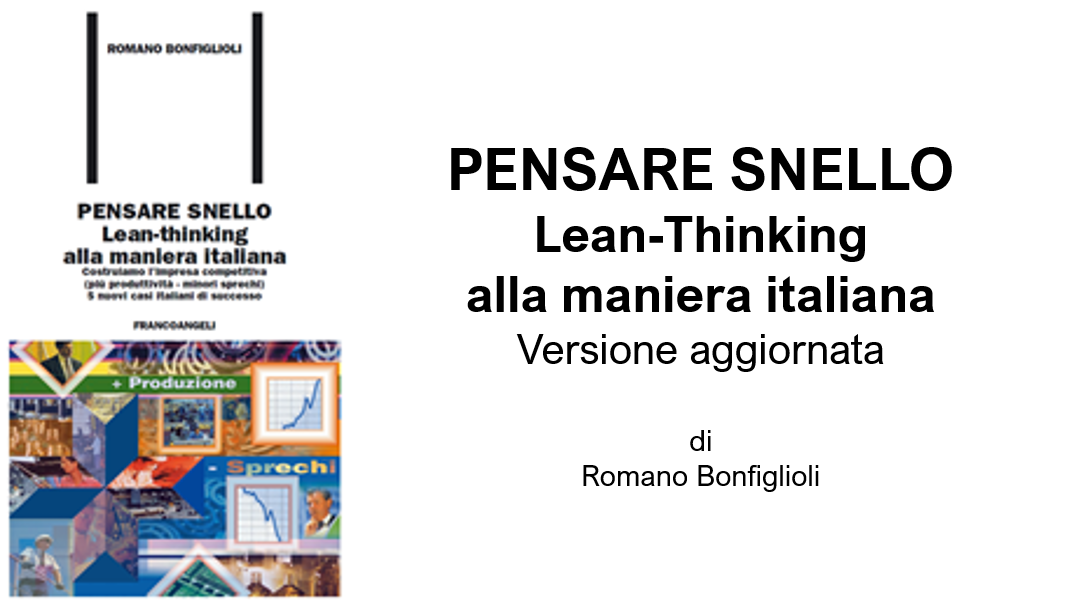
Company after company, case after case, application after application, Romano Bonfiglioli’s team built a database, and with five new cases of ’successful lean thinking,“ there was material for a new book… but there was also the need to meet the unfulfilled demand for the first edition of the book.
Thus was born the updated and expanded edition of ”Lean Thinking, the Italian Way.“
In terms of the number of concrete applications of lean thinking in companies, Bonfiglioli Consulting’s experience is unique and holds a record in Italy: ”which is now in demand and being exported to France, Germany, and England,“ explains Romano Bonfiglioli.
The formula is simple: ”Lean thinking,” concludes Bonfiglioli, “is a true cultural revolution that produces astonishing results when implemented rigorously—that is, by applying the principles ‘to the letter.’ You won’t achieve results if you make compromises, if you tolerate half-baked projects to avoid tackling difficult situations or to keep everyone happy.”
Only in this way can delivery times for the 70% be reduced by 70% or more, the same goes for inventory and scrap in the 60%, as well as the space used for warehousing, and so on, right up to the results achieved by companies that have tested lean thinking in the Italian style of Romano Bonfiglioli.
This new book guides managers and entrepreneurs step by step through the world of pursuing managerial efficiency, and reading it becomes a true operational “manual” to be read and reread—not only to compare the results achieved but also to find the right analytical tools when the inevitable difficulties that accompany any real change in Italian companies arise.


 ai translated