The methodology for improving the transformation cost
The World Class Manufacturing (meaning of the acronym WCM) is a philosophy corporate focused on creating value for the Customer. Among the cornerstones of WCM is pull logic production, i.e., the creation of a continuous flow driven by Customer needs, with lead time reduction, waste elimination and quality improvement. All with a view to continuous improvement.
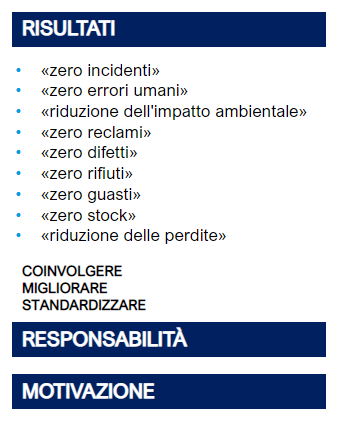
The concept of great coincides, according to WCM, at the value zero: zero waste, zero inventory, zero accidents, zero failures, zero defects, and zero customer dissatisfaction. To make the improvements achieved effective and long-lasting, one must focus on standardization and involvement of the customer first and foremost and of the people in the company (employees/collaborators) by making everyone feel an integral and responsible part of the change.
Underlying the WCM are. 10 technical pillars e 10 managerial pillars.
Each Pillar consists of 7 Steps that bring the company from a state Reactive (one reacts when a problem arises) to one Quote (uses experiences to avoid recurrence of problems that have already occurred, including similar problems in other conditions), to goal a state Proactive (In accordance with the Risk Assessment risk analysis, it uses the appropriate corrective actions to prevent the possibility of a specific problem from happening.) Once the proactive stage is reached, the company tends to become a benchmark.
A pillar can be understood as an organic area of improvement.
Each pillar is managed by a Pillar Leader, Who is responsible for implementing progressive improvements to their pillar.
The Pillar Leader is not only the hierarchical manager of the area, but is the owner of methods and tools for improvement.
I 10 technical pillars Are as follows:
I 10 managerial pillars Are:
The 10 managerial pillars carry the same weight as the technical ones, but They guide the company's management toward the right decision-making process, in order to increase results and optimize processes of improvement and integration between technical pillars.


 ai translated