The article addresses the topic of corporate business academy, explaining what it is, why it is strategic today and how to build it effectively. An academy is not simply a catalog of courses, but an organized and continuous system for developing people’s skills, standardizing onboarding, preserving know-how, and supporting the growth of the company over time.
The heart of the content is a 5-step method developed by Bonfiglioli Consulting: it starts with defining the “why” (alignment with the strategy), then moves on to analyzing the current situation, designing the model, implementing it through a pilot, and finally scaling the system.
The article also proposes a practical architecture divided into four flows (onboarding, skills growth, new technologies and openness to the outside world) and presents three real cases in the packaging, manufacturing and industrial sectors that show how the Academy can generate concrete results in multiple areas: reducing turnover, improving operational indicators and strengthening relationships with customers and suppliers.
Finally, the myth that the Academy is only suitable for large enterprises is dispelled: even SMEs can build their own training system, starting from a limited scope and gradually expanding it. The article concludes with a list of the most common mistakes to avoid, first and foremost the failure to link the Academy to the company’s strategy.
Training people has always been important. But today it’s no longer enough to do it “when needed”: the companies that hold the competition are the ones that have transformed training into a permanent system, capable of accelerating onboarding, preserving know-how, and developing skills in line with the strategy. Building a Corporate Academy is the most effective way to do this.
An Academy is not a catalog of courses or a collection of disconnected training initiatives. It is an organized model for transferring skills, standardizing onboarding, spreading corporate culture, and supporting the development of the enterprise over time.
A corporate Academy is the system through which an enterprise continuously forms, develops and enhances its people, not episodically. Its goal is not only to provide content, but to oversee the entire cycle of skills development: onboarding, growth, upskilling, dissemination of best practices, and generational transition.
The difference compared to traditional training is substantial. In many contexts, training is episodic and reactive; an Academy, however, operates with a stable and progressive logic, capable of responding to immediate needs, preventing future gaps, and preparing the organization for the transformations that will come.
Businesses are faced with increasingly complex challenges: a shortage of skills, the need for upskilling and reskilling, the risk of losing know-how, and an increasing focus on employee engagement. In this scenario, the Academy is not just a training tool but an organizational lever that helps ensure continuity, quality, and adaptability.
The main advantages of a corporate academy therefore concern both the operational and strategic dimensions:
In other words, a Corporate Academy helps the company grow without relying exclusively on informal experience or the availability of individuals. The skills required for the future of work are at the heart of the World Economic Forum’s 2025 Future of Jobs Report.
Before designing the training system, it is also useful to think in terms of Change Management, because the Academy is first and foremost an organizational transformation project.
One of the most common mistakes is to start with the courses. In reality, the first step is to define why the Academy must be created and what business problem it must solve.
To design an effective training system, Bonfiglioli Consulting starts with the definition of four key levers:
This initial work is crucial because it avoids creating an elegant corporate structure on paper but disconnected from the real needs of the organization.
The construction of an Academy also requires consistency between strategy and action, following a logic similar to that of Hoshin Kanri. To build an effective corporate Academy, Bonfiglioli Consulting has developed a 5-step process that guides the company from the definition of the strategy to the standardization of the model.
5-step model for building a corporate academy
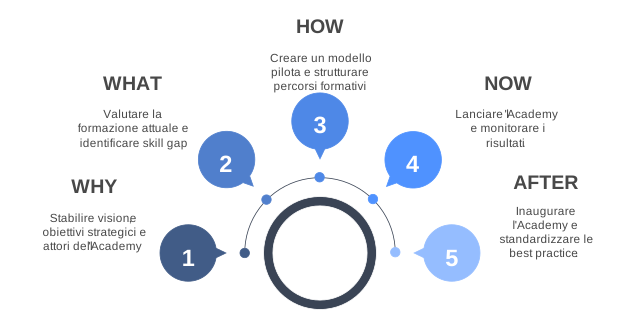
The foundations are being built here. The Academy must be aligned with the company’s strategy, involve key stakeholders, and establish clear success criteria, both in terms of quality and organization.
If this phase is lacking, the risk is to create a project perceived as a "HR initiative“ instead of a concrete lever of competitiveness.
This phase serves to photograph the starting situation. The company maps the onboarding and training processes, identifies skill gaps, analyzes the organizational structure, and assesses available tools, technologies, and support.
The analysis is the moment when the real question emerges: where is the educational value being lost today and where is it worth intervening first.
Once the AS-IS is understood, the TO-BE model is drawn up. Here, the new onboarding and development processes, roles, tools, governance logic, and any external partner contributions are defined.
This is the moment when the internal training system stops being an intention and becomes an operational project.
The implementation should start with a pilot. Testing the Academy on a limited scale allows for the verification of content, flows, responsibilities, and delivery methods before expanding it.
This phase is important because it reduces the risk of building an infrastructure that is too theoretical and not closely aligned with the company’s reality.
When the pilot is successful, the model can be expanded. This leads from experimentation to an organizational infrastructure that disseminates standards, speeds up learning, and makes the development of people more consistent.
Upskilling does not just mean increasing the number of courses, but consolidating a culture of continuous learning.
Not all corporate academies have to have the same structure. A useful model, especially in industrial contexts, is the one structured into four streams:
This diagram shows that a Corporate Academy serves not only to "provide training“, but also to build connections between internal competencies, innovation, and external relationships.
In an industrial packaging reality, the initial problem was clear: the onboarding of new people depended too much on individual departments and the informal experience of colleagues. The result was a less uniform onboarding process, with varying timing and content.
Working together with the internal team, Bonfiglioli Consulting built the intervention around three key elements:
The onboarding was organized as a structured experience in the first weeks of entry, including company history, products, processes, tours of the departments, security, and employee services. A concrete example of how an Academy works when it makes the learning experience consistent from the very first contact with the company.
In a manufacturing company with a high technological component, the problem was not only educational. The organization needed to align the growth of skills, corporate culture, leadership, and strategic vision.
The path initiated with Bonfiglioli Consulting led to establishing the Academy not as a simple center for technical training, but as a driving force for organizational development. The objectives included:
This case illustrates a key point: a mature Academy does not just fill gaps; it also helps build identity, belonging, and consistency between people and strategy.
In an industrial company that is a market leader in Europe with over 50 years of history, the Academy was founded with a precise objective: to train all the people in the organization, while valorizing the technical know-how accumulated over decades of activity.
The adopted model was that of an "open“ Academy, structured around four streams — onboarding, skills development, new technologies, and openness to the outside world — with an internal technical faculty certified ”train the trainer“ and a dedicated physical space created within the factory premises.
The results obtained during the first period of activity — measured together with the Bonfiglioli Consulting team — covered several dimensions: a reduction in absenteeism and turnover among the direct staff, an improvement in operational indicators related to human errors and waste, and a concrete strengthening of the partnership with customers and suppliers through dedicated training sessions. This is a case that demonstrates how investing in the Academy means investing in the entire production ecosystem, not only in internal personnel.
The standardization of training programs also helps strengthen the logic of Operational Excellence. When launching a Corporate Academy, some common mistakes often occur:
The biggest mistake, however, is to consider the Academy as an accessory project. If it is not linked to the strategy and the real processes, it risks remaining an empty container.
A recurring question is whether a corporate academy is only suitable for large companies. The answer is no.
Even a small or medium-sized enterprise can build its own internal training system, provided it is proportionate to its complexity. It is not necessary to start with a heavy structure: often it is more effective to start with a clear framework — onboarding, critical department skills, and transferring technical know-how — and then extend the model over time.
For an average company, the benefit can be even greater. Where knowledge is concentrated in a few expert figures, every departure or change of role exposes the organization to a loss of continuity that a well-designed Academy can significantly reduce.
Building a corporate Academy means taking a leap of maturity: moving from fragmented training to a system that develops skills, culture, and organizational continuity. This is an even more important choice when the company wants to grow, innovate, and quickly hire new people while protecting its own know-how.
The real question is not which courses are needed today, but what learning system the company needs to support its strategy for tomorrow.
Bonfiglioli Consulting has been assisting companies in building Corporate Academies for over 12 years. Through the Lean Factory School® — active since 2012 with over 4,000 participants trained, more than 10,000 hours of training delivered and a Customer Satisfaction index of 3.8 out of 4 — it has developed a method tested on more than 850 cross-industry companies. This experience allows it to accompany every Academy project from defining the vision to its rollout, with a personalized approach based on the reality of each organization.
Timelines vary depending on the complexity of the organization and the scope of the project. Typically, an Academy project starts with a two- to three-month analysis and planning phase, followed by a pilot on a limited scope. The full rollout can take between six months and a year. Starting in a structured way — even on a small scale — is more effective than waiting until everything is ready.
A training plan is a list of training activities planned for a defined period. A corporate academy, on the other hand, is a permanent system: it has governance, defined roles, structured processes, and dedicated tools. It does not replace the training plan, but it provides a stable organizational logic that extends beyond the individual year.
Yes. A corporate academy does not necessarily require high investments or complex structures. In SMEs, the most effective model is often the lightweight and focused one: structured onboarding, paths for critical skills, and systems for the transfer of know-how. Even with limited resources, the return in terms of operational continuity and reduction of errors is measurable in the short term.
The effectiveness indicators of a corporate academy are measured at multiple levels: the participants" reaction (satisfaction), actual learning (pre-and post-assessments), transfer to the workplace (changes in operational behaviors), and impact on the business (reduction in errors, onboarding times, turnover, productivity). Defining these KPIs before the start — and not after — is one of the elements that distinguishes a mature academy from a traditional training initiative.
Did it help you? Add it as your preferred source on Google



 ai translated