
Contemporary economic thought is based on the principle that if everyone efficiently pursues their own economic interests, they automatically serve the interests of society as well. And since businesses are organizations established to pursue their own economic interests, it would follow that what is good for the business is good for society. Today, everything around us tells us that a predatory economy—one that relentlessly plunders human, mineral, and agricultural resources, among others, for its own gain—is no longer sustainable. And so, some are attempting to turn this paradigm on its head.
Among the most interesting stops on the Lean Japan Study Tour organized by Bonfiglioli Consulting is a factory in Kyoto where high-tech production is combined with a work environment that encourages everyone to realize their unique potential. Founded in 1986, Omron Kyoto Taiyo (Omron Corporation) currently employs over 150 people with disabilities—including those with severe disabilities—under the motto “Not charity, but a chance.” The key lies in assistive devices and technological, IT, and automation tools tailored to each individual’s needs and capabilities in order to maximize their skills. If a worker has limited mobility, a machine assists them by bringing components closer so they can easily grasp them. Or take the bagging phase, for example. During this process, resealable plastic bags are automatically brought to the machine operator’s hand and opened. If the operator has difficulty grasping the components because they are too small, the machine takes over. Otherwise, if the components are large enough, the operator handles them independently. The entire process unfolds in full synergy according to each person’s abilities, thereby creating the best possible partnership between human and machine. Choosing the wrong component is a common mistake that anyone can make, regardless of disability; therefore, sensors installed on the shelves detect which shelf the component was taken from, and an alarm sounds if a component is selected incorrectly or forgotten. And if the type of product to be manufactured or the components to be used changes, and the operator is replaced by a new person, the workbench will be replaced with a new one adapted to the new operator. The concept is to allow machines to adapt to human operators, rather than the other way around, in order to bring out the full range of skills in each operator. The presence of engineers supports workers facing challenges by focusing on each worker’s unique potential. Improvement must start in the factory and expand outward: top-down management does not work.
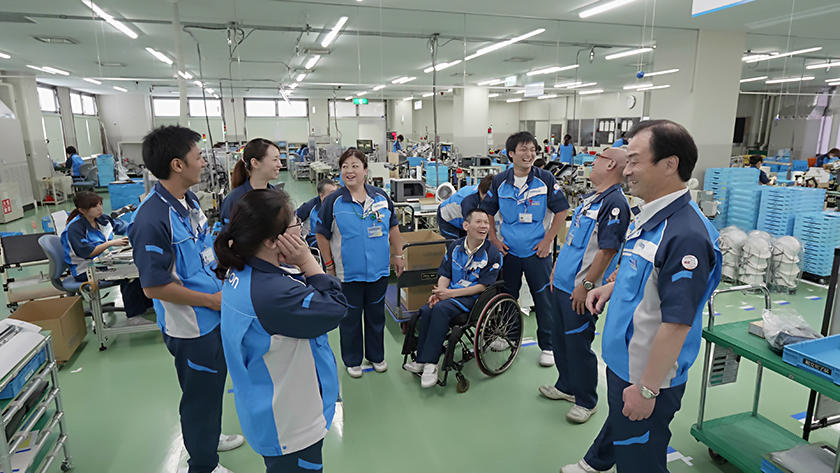
The organization’s core philosophy is to harness the potential underlying disability and maximize the abilities of people with disabilities by providing mechanical aids—including assistive devices and tools—as well as kaizen improvements in their work environment.
Corrado Di Perna, Business Development Manager at Bonfiglioli Consulting
Omron’s management philosophy is people-centered, allowing the skills and abilities of each individual to be put to good use—an aspect that many companies, even those outside the manufacturing sector, can learn from. Omron
Kyoto Taiyo has achieved ISO 9001 certification with a quality management system that meets global standards. Today, this successful and profitable company demonstrates that by consciously pursuing what is good for society, companies also serve their own best interests—that is, their true benefit.


 ai translated