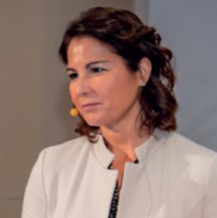
Marta Bertolaso, professor of philosophy of science and human development at the University Campus Bio-Medico in Rome | Impresa&Imprese 1/2021
It is not the change that displaces us, but the feeling that something with the change is eluding us and is dimly aware.
Marta Bertolaso, professor of philosophy of science and human development at the Campus Bio-Medical University of Rome
The pervasiveness of technology in the personal and professional spheres is changing not only lifestyles and ways of working, but also cognitive processes, reorganizing the perception of the world and interpersonal relationships, formal and informal. Once again, as in the Renaissance, the challenge will be to place man and the common good at the center of the interests and goals of business and society: only in this way will we be able to overcome that sense of unease that every change with its charge of the unknown inevitably brings with it. According to Marta Bertolaso, Professor of Philosophy of Science and Human Development at the University Campus Bio-Medico in Rome, if Digital Renaissance must be, let it be from the We.
"We live in an uneasy, crisis-ridden world where what seems to work best, namely technology, sometimes seems to feed on the very crises. In recent months, for example, digitization has enabled us to solve several organizational, work and educational problems. Despite this, we continue to experience the perception that something that used to belong to us is disappearing and can no longer be recovered. The problems of contemporary society are thus related to the fears that such crises generate. The question to ask at such times is: how did we get to this point?
The first point to investigate is the collapse of global dynamics on local ones. If viruses and machines used to be found only in history books, today they have entered our lives revolutionizing their style. Likewise, we cannot ignore elements such as sustainable development and new economy implementation processes. Smart working is a clear example of this. According to a study by the Polytechnic, in four months we have produced data that had been predicted over four hundred years. This means that it is necessary to review the security systems that protect our spaces and that we must learn to manage them in a totally new scenario. Revising habitual processes generates anxiety because we are forced to confront something new that we had never experienced. Equally important is to consider the desire for autonomy, which at this time is delegated to machines. A fact that facilitates many things for us, but also creates many questions. From interactions with Alexa in the morning to those with social media in the evening, via the App that tells us what to eat or when to go to sleep, we are generating an immense amount of data, about 10,000 gigabytes, with doubling times normally referable to a year, now destined to drop to 12 hours in a few months. These numbers indicate that we live in a dimension of collective intelligence that excludes no one and with which we must perforce come to terms.
On closer inspection, therefore, it is not the change that displaces us, but the feeling that something with the change is eluding us and is dimly aware.
The question, then, becomes: what form does fear take today? I would say that we could sum it up with the terms loneliness and isolation. Loneliness is, for example, that of the CEO who does not know whom to consult or whom to ask for advice. It is a real and shared loneliness, which has part of its raison d'être in the dematerialization of relationships. Based on these premises, it is therefore clear that there is a need to realize a new way of doing business and a new model of "vital" and transformational leadership. Today, the solution we need to put in place to train the new generations lies in the radicalization of the crisis and the ability to transform difficulties into choices and judgment.
The first answer is to start again from the We. Something we have lost in corporate organizational models. Our management models are based on the fact that people in a work environment tend to seek their own benefit. We are at a time when it is instead necessary to bet on other qualities of the human being, namely the ability to identify the common good and build it together. If in the past, we overcame crises by leaving something behind, today the challenge is to radically live the situation we are in with choice and judgment: these are the capacities we need to bring into play.
Man must become aware that he can do something that machines cannot: use interruptions. What seem like pauses that machines would perceive as a lack of data, man is able to make them into a horizon of meaning. That is where something new can be built. This means getting out of the paradigm of confronting machines in functional terms. The problem is that we have always compared ourselves with machines on our performance that we are forced to overcome: impossible to win!
Take for example the contribution machines can make to us in managing the most important resource: time. Our own time and the time of others. Elias Canetti in "The Province of Man" writes "Everything became faster because there was more time." Instead, in our world, there seems to be less and less time. This feeling of lack of time or not knowing how to use it is one of the most interesting challenges. In classical culture, the Greeks knew that time has two meanings: time that is imposed on us and marks our passage on this earth, and time as the ability to know how to seize the opportunity. That is, doing the right thing at the right time. Therefore, it is not enough to have time if we do not know how to seize the right moment, and this ability is peculiar to man alone, and on it we must train future generations.
Machines may help us in repetitive, precision or heavier jobs, but seizing the right moment to do the right thing is a skill that cannot belong to machines. There is no algorithm for it, only brain and heart put together in instant synthesis.
Watch the video regarding Marta Bertolaso's speech during "Digital Renaissance - What Intelligence for the Recovery?", the event promoted by the Professional Services Sector of Confindustria Emilia, in collaboration with 15 other territorial branches of the System, which was held on October 6, 2021 at the Military Academy in Modena.


 ai translated